

Friday, January 30, 2009

Thursday, January 29, 2009
Riding Canes
Riding canes are used for queues normally given to the horse on the right side. The rider can either lightly touch or tap the horse on the right side when asking for the left canter as well as when she needs the horse to bend to the right.
These canes come in many styles and sizes. My friend Brita told me this: "The hunting whips with the stag horn handles were used to reach out and grab gates, and the lashes were used to swish the hounds away from the horses, or as makeshift leashes."
They can be rather plain leather covered sticks..
.or quite elaborate with wonderful ornate tops.
Who would not love to own a riding cane that once belonged to their Great Grandmother!
Even when riding aside in a saddleseat competition, the traditional riding whip can be exchanged for a thicker and more stiff cane.
These canes come in many styles and sizes. My friend Brita told me this: "The hunting whips with the stag horn handles were used to reach out and grab gates, and the lashes were used to swish the hounds away from the horses, or as makeshift leashes."

They can be rather plain leather covered sticks..

.or quite elaborate with wonderful ornate tops.

Who would not love to own a riding cane that once belonged to their Great Grandmother!

Even when riding aside in a saddleseat competition, the traditional riding whip can be exchanged for a thicker and more stiff cane.

Wednesday, January 28, 2009
Disappointed..
Last Sunday I was suppose to take a lesson with my instructor using the rescued 12 year old Saddlebred I want to try riding aside. A big part of this lesson was going to be seeing if my sidesaddle would work on this boy and then taking the measurements for the other equipment I need to buy. Well, Chastian had been a show horse for a long long time. He has been at my farm for a couple of years although I have been his registered owner for only a few months. It NEVER dawned on me he needed a refresher class in trailer loading!!! I had to cancel my lesson because after an hour, I could only get him to step in half way (front 2 feet). :0(
Tuesday, January 27, 2009
My Safety Stirrup!
My safety stirrup arrived from Hundred Oaks and it is STUNNING! Solid brass, well made and a crowning piece to my saddle! Thanks Marti!
 Thanks Marti!
Monday, January 26, 2009
Saddle Fit for the Rider
..okay - so excuse the ugly blue socks!
This is me trying to balance on my saddle while it is sitting on the back of a chair. It was hard to balance - to say the least!
By the feel of it, I thought that there was about 1.5 inches of space behind me - but in looking at these pictures, I think this saddle is about as perfect a fit as I could get!...dag blasted Christmas cookies! ha ha

This is me trying to balance on my saddle while it is sitting on the back of a chair. It was hard to balance - to say the least!

By the feel of it, I thought that there was about 1.5 inches of space behind me - but in looking at these pictures, I think this saddle is about as perfect a fit as I could get!...dag blasted Christmas cookies! ha ha

Sunday, January 25, 2009
My Saddle
Okay - the first pictures were so dark - I redid them, making them lighter! This is my Champion and Wilton Sidesaddle.
There is some wear on the heads, but what you see on the flap is a reflection of light.
The leather is very supple and the billets must have been redone recently. They are in very good shape.

There is some wear on the heads, but what you see on the flap is a reflection of light.

The leather is very supple and the billets must have been redone recently. They are in very good shape.


Saturday, January 24, 2009

Friday, January 23, 2009
~Spoiler~
Next week I should have some pictures of my new-to-me (used) Champion and Wilton sidesaddle!
The Sandwich Case
On the off side of a sidesaddle you will most likely have 2 small metal rings. These rings are where you would attach a small leather sandwich case.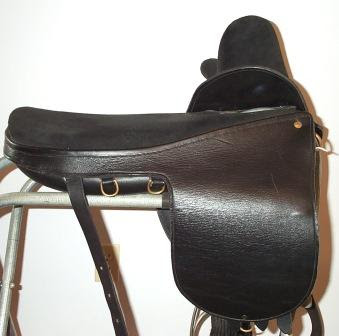
These small cases were equip with a small tin box and a crystal flask. Traditionally a lady would wrap up a ham sandwich in a linen napkin (no sandwich spread was used so the small meal would not sour!) and the flask would either contain Sherry or Tea.
Depending on the age and condition of an antique sandwich case, the cost can be several hundred dollars!
..but if you enjoy sticking to tradition, what a lovely picture it makes!

These small cases were equip with a small tin box and a crystal flask. Traditionally a lady would wrap up a ham sandwich in a linen napkin (no sandwich spread was used so the small meal would not sour!) and the flask would either contain Sherry or Tea.

Depending on the age and condition of an antique sandwich case, the cost can be several hundred dollars!

..but if you enjoy sticking to tradition, what a lovely picture it makes!

Thursday, January 22, 2009
If You Have the Hat - You Must Have a Hat Box!
If you have ever been to a typical horse show, you know how dusty and dirty everything can get! Simple things like garment bags and hat boxes are not a luxury, but a necessity if you want your habits to last. Here are some fun and unique hat boxes I found to share with you.
From the traditional...
..to the fun, investing in one will pay for itself.
Oh - I like this one!
...and shall we just call this - The Cat in the Hat Box!

From the traditional...
..to the fun, investing in one will pay for itself.

Oh - I like this one!

...and shall we just call this - The Cat in the Hat Box!

Wednesday, January 21, 2009
Tuesday, January 20, 2009
Top Hats
I wanted to show you the difference between a Saddleseat Top Hat here..
..and a more traditional Sidesaddle Top Hat here..
This beautiful sidesaddle rider is wearing the traditional taller top hat. When I compete on my Saddlebred, I will wear the lower top hat shown in the first picture.

..and a more traditional Sidesaddle Top Hat here..
This beautiful sidesaddle rider is wearing the traditional taller top hat.
 When I compete on my Saddlebred, I will wear the lower top hat shown in the first picture.
Friday, January 16, 2009
They Even Make a Special Sidesaddle Rack!
 The picture is pretty self explanatory, but I still wish there was an additional photo with the saddle resting on it.
Wednesday, January 14, 2009
Sidesaddle Rider Exercises!
Look what my friend Pam sent me:
Unmounted Exercises
Hip and glut. stretch
Sit on a straight chair, feet flat on the floor. Cross right leg over the left leg. Rest the outside of your right calf on top of your left thigh. Grasp right ankle with left hand. GENTLY pull right ankle toward left hip. At the same time, press right knee downward toward floor. Keep stretch steady and smooth, do not bounce or pulse. Only stretch until you feel discomfort. Do not stretch until your discomfort turns to pain. Hold stretch for a slow count of 5. SLOWLY release right ankle, uncross legs and set right foot back on floor.
Lift right foot off floor and swing knee to the right as far as it will go comfortably. Pause. Swing leg back to starting point. Set foot back on the floor. Extend right leg straight in front of you and hold for a count of 3. Repeat this stretch and release 5 or 6 times, once or twice a day.
2. Knee and ankle strength and stretch
Standing up straight, lift left foot off floor however is most comfortable for you. Bend right leg at the knee, SLOWLY lower yourself as far as you can without lifting right heel off of floor. DO NOT BOUNCE. Hold for a slow count of 5. SLOWLY rise up until leg is again straight.
Now stand on left foot and raise right foot off floor. SLOWLY bend and straighten your right knee several times. DO NOT KICK. Next rotate right ankle in a circular motion, first one way then the other. Return foot to floor. Repeat this stretch and release 5 or 6 times, once or twice a day.
Thigh strengthener
Standing up straight, SLOWLY lift right leg ahead of you as high as you are able. Hold leg extended for a slow count of 5. Be sure to concentrate on using your thigh to hold up leg, not your back. SLOWLY lower leg, then bend and straighten knee several times. DO NOT KICK. Repeat this exercise 5 or 6 times, once or twice a day.
Calf stretch
On a step or stair, stand on balls of feet with heels extending over edge.
SLOWLY lower your heels until you feel discomfort. DO NOT BOUNCE. Hold for a slow count of 5. Rise back up to level. Pause. SLOWLY rise up to tip toe. Hold for slow count of 5. SLOWLY lower heels down past level until you feel discomfort. Hold for slow count of 5. Step down. Repeat this stretch and release 5 or 6 times, once or twice a day.
Foot coordination
Sitting in a chair, hands on each side of hips to support weight. Raise feet slightly off of floor and ahead of you. Point right toes down and left toes up. Return feet to being even with each other. Repeat rapidly 15 times once or twice a day. Note this is a coordination exercise, not a stretching exercise. Do not strain ankles. It is important to have feet completely off of floor. Do not rest heels on floor. DO NOT increase repetitions of this exercise as it will put undo strain on your lower back.
6. Thigh balance
Sit on corner edge of table or desk on right thigh and seat. Hang right lower leg and foot over table or desk edge in front of you. Support your weight with left foot on floor. Shift weight to right thigh while raising left foot off floor. Concentrate on weight being centered on thigh rather than seat. Sit up straight, do not lean forward or sideways. Hold for a slow count of twenty. This is a balance exercise, there should be no straining. If you feel as though you need to lean far to the right to lift foot off floor, scoot your seat over to the right about an inch. Try again. Continue to scoot over an inch at a time until you are just barely balancing on edge of the table. Hold balance for a slow count of 20. If you start to teeter hold for a shorter count and work your way up to 20.
Mounted Exercises
Foot coordination
While warming up your horse at the walk with feet in stirrups, raise right heel up and drop left heel down. Remain evenly balanced in saddle. Try doing this quickly. Right heel up, at the same time, left down. Some riders are able to do this easily. Others have a hard time having their feet go in different directions.
When you are ready to move into the trot, again raise right heal and drop the left heel. Ease into a sitting trot using your seat for balance, not the stirrups. Only rest feet lightly in stirrups. Then try doing it quickly as you
did at the walk. I wouldn’t suggest posting this way, your horse may never forgive me.
The reason for this exercise is to be able to use light purchase while riding aside. You will occasionally need just a little more security than your balance alone. As you will learn in a future segment, purchase means to stabilize yourself in the sidesaddle. A light purchase is achieved by pointing your right toe down. What many riders do is also raise their left heel at the same time. This foot coordination exercise and the unmounted one (no. 5) helps to teach you to work your feet independently.
Balance exercise
Ride bareback! Balance yourself with your seat, not your horse’s mouth via the reins. Again, practice right toes down, left heel down. Keep ankles soft, don’t tighten legs. If you’re concerned your horse has too rough of a trot and/or canter, just walk. It will still do you a world of good.
Move back
If you do not ride saddleseat borrow a Lane Fox tree cutback saddle. It’s best to use a flat seat rather than the deeper equitation seat. Typically a flat seat will have a square cantle while an equitation seat will have a round cantle. Riding in a cutback will give you some of the sense of sitting farther back on the horse as you will be riding sidesaddle. You will also be able to practice riding with the longer reins required for sidesaddle. When sitting farther back you will have to have longer reins in order not to have your arms stretched out in front of you.
There are no built in “tricks” to hold you in place on a cutback. The flat seat is designed to allow the rider to shift forward or backward on the seat while executing the various gaits. Staying in one spot, which is what you are aiming for, can be a challenge. Built without knee blocks or deep seats as hunt or dressage saddles are, while riding these saddles it is completely up to the rider to maintain their balance.
Practice the correct saddleseat leg. Ride with feet pointing more forward than in hunt seat. DO NOT turn toes in, instead rotate heels out. This will engage your entire leg into the saddle from the calf all the way to the hip.
New Cues
Practice cueing your horse with only your left leg and your seat. This will give you and your horse a head start before the new saddle and riding position begin.
If your horse does not understand only one leg, use a sidesaddle cane to replace your right leg. Use your cane in the same position and with the same pressure as you would your leg. Some horses pick up weight shift cues, others rely on the cane, while some work better using both. Each horse is different. Experiment to see what works best for your horse. Combining the new cues with the cutback saddle and longer reins, along with the exercises you and your horse will be well on your way to riding aside.
Unmounted Exercises
Hip and glut. stretch
Sit on a straight chair, feet flat on the floor. Cross right leg over the left leg. Rest the outside of your right calf on top of your left thigh. Grasp right ankle with left hand. GENTLY pull right ankle toward left hip. At the same time, press right knee downward toward floor. Keep stretch steady and smooth, do not bounce or pulse. Only stretch until you feel discomfort. Do not stretch until your discomfort turns to pain. Hold stretch for a slow count of 5. SLOWLY release right ankle, uncross legs and set right foot back on floor.
Lift right foot off floor and swing knee to the right as far as it will go comfortably. Pause. Swing leg back to starting point. Set foot back on the floor. Extend right leg straight in front of you and hold for a count of 3. Repeat this stretch and release 5 or 6 times, once or twice a day.
2. Knee and ankle strength and stretch
Standing up straight, lift left foot off floor however is most comfortable for you. Bend right leg at the knee, SLOWLY lower yourself as far as you can without lifting right heel off of floor. DO NOT BOUNCE. Hold for a slow count of 5. SLOWLY rise up until leg is again straight.
Now stand on left foot and raise right foot off floor. SLOWLY bend and straighten your right knee several times. DO NOT KICK. Next rotate right ankle in a circular motion, first one way then the other. Return foot to floor. Repeat this stretch and release 5 or 6 times, once or twice a day.
Thigh strengthener
Standing up straight, SLOWLY lift right leg ahead of you as high as you are able. Hold leg extended for a slow count of 5. Be sure to concentrate on using your thigh to hold up leg, not your back. SLOWLY lower leg, then bend and straighten knee several times. DO NOT KICK. Repeat this exercise 5 or 6 times, once or twice a day.
Calf stretch
On a step or stair, stand on balls of feet with heels extending over edge.
SLOWLY lower your heels until you feel discomfort. DO NOT BOUNCE. Hold for a slow count of 5. Rise back up to level. Pause. SLOWLY rise up to tip toe. Hold for slow count of 5. SLOWLY lower heels down past level until you feel discomfort. Hold for slow count of 5. Step down. Repeat this stretch and release 5 or 6 times, once or twice a day.
Foot coordination
Sitting in a chair, hands on each side of hips to support weight. Raise feet slightly off of floor and ahead of you. Point right toes down and left toes up. Return feet to being even with each other. Repeat rapidly 15 times once or twice a day. Note this is a coordination exercise, not a stretching exercise. Do not strain ankles. It is important to have feet completely off of floor. Do not rest heels on floor. DO NOT increase repetitions of this exercise as it will put undo strain on your lower back.
6. Thigh balance
Sit on corner edge of table or desk on right thigh and seat. Hang right lower leg and foot over table or desk edge in front of you. Support your weight with left foot on floor. Shift weight to right thigh while raising left foot off floor. Concentrate on weight being centered on thigh rather than seat. Sit up straight, do not lean forward or sideways. Hold for a slow count of twenty. This is a balance exercise, there should be no straining. If you feel as though you need to lean far to the right to lift foot off floor, scoot your seat over to the right about an inch. Try again. Continue to scoot over an inch at a time until you are just barely balancing on edge of the table. Hold balance for a slow count of 20. If you start to teeter hold for a shorter count and work your way up to 20.
Mounted Exercises
Foot coordination
While warming up your horse at the walk with feet in stirrups, raise right heel up and drop left heel down. Remain evenly balanced in saddle. Try doing this quickly. Right heel up, at the same time, left down. Some riders are able to do this easily. Others have a hard time having their feet go in different directions.
When you are ready to move into the trot, again raise right heal and drop the left heel. Ease into a sitting trot using your seat for balance, not the stirrups. Only rest feet lightly in stirrups. Then try doing it quickly as you
did at the walk. I wouldn’t suggest posting this way, your horse may never forgive me.
The reason for this exercise is to be able to use light purchase while riding aside. You will occasionally need just a little more security than your balance alone. As you will learn in a future segment, purchase means to stabilize yourself in the sidesaddle. A light purchase is achieved by pointing your right toe down. What many riders do is also raise their left heel at the same time. This foot coordination exercise and the unmounted one (no. 5) helps to teach you to work your feet independently.
Balance exercise
Ride bareback! Balance yourself with your seat, not your horse’s mouth via the reins. Again, practice right toes down, left heel down. Keep ankles soft, don’t tighten legs. If you’re concerned your horse has too rough of a trot and/or canter, just walk. It will still do you a world of good.
Move back
If you do not ride saddleseat borrow a Lane Fox tree cutback saddle. It’s best to use a flat seat rather than the deeper equitation seat. Typically a flat seat will have a square cantle while an equitation seat will have a round cantle. Riding in a cutback will give you some of the sense of sitting farther back on the horse as you will be riding sidesaddle. You will also be able to practice riding with the longer reins required for sidesaddle. When sitting farther back you will have to have longer reins in order not to have your arms stretched out in front of you.
There are no built in “tricks” to hold you in place on a cutback. The flat seat is designed to allow the rider to shift forward or backward on the seat while executing the various gaits. Staying in one spot, which is what you are aiming for, can be a challenge. Built without knee blocks or deep seats as hunt or dressage saddles are, while riding these saddles it is completely up to the rider to maintain their balance.
Practice the correct saddleseat leg. Ride with feet pointing more forward than in hunt seat. DO NOT turn toes in, instead rotate heels out. This will engage your entire leg into the saddle from the calf all the way to the hip.
New Cues
Practice cueing your horse with only your left leg and your seat. This will give you and your horse a head start before the new saddle and riding position begin.
If your horse does not understand only one leg, use a sidesaddle cane to replace your right leg. Use your cane in the same position and with the same pressure as you would your leg. Some horses pick up weight shift cues, others rely on the cane, while some work better using both. Each horse is different. Experiment to see what works best for your horse. Combining the new cues with the cutback saddle and longer reins, along with the exercises you and your horse will be well on your way to riding aside.
Tuesday, January 13, 2009
Riding Corsets!
In researching riding aside, I found that TODAY, many ladies like wearing corsets when they ride! Wow - I always viewed corsets as being binding, tight, restricting and well just plain uncomfortable! At the turn of the 20Th century, ladies knew the standard dress corset would not work for riding - so the Riding Corset was invented.
It's purpose was not to "wasp" the waist, but rather give support to the back and bust, yet allow free movement at the waist and hip. Notice how it flairs away at the bottom.

It's purpose was not to "wasp" the waist, but rather give support to the back and bust, yet allow free movement at the waist and hip. Notice how it flairs away at the bottom.

Monday, January 12, 2009
How Would You Handle This in a Sidesaddle??
Pictures from my lesson on Saturday morning!..
..and NOOOOO - this is not the horse I want to learn sidesaddle on!
..but once he gets the hang of working clockwise..I do think he will be one darn good show horse!
Here is our goal!

..and NOOOOO - this is not the horse I want to learn sidesaddle on!

..but once he gets the hang of working clockwise..I do think he will be one darn good show horse!

Here is our goal!

Friday, January 9, 2009
How to Tie a Stock Tie..
Again, this is not something that would be in the standard costume of Saddleseat, but for any hunt sidesaddle riders, it is very good info!
...and what the finished product should look like!.jpg) Did you know that Stock Ties came to be out of necessity? Although very fashionable, they double as a valuable piece of first aid equipment - used as a tourniquet!
Did you know that Stock Ties came to be out of necessity? Although very fashionable, they double as a valuable piece of first aid equipment - used as a tourniquet!

...and what the finished product should look like!
.jpg) Did you know that Stock Ties came to be out of necessity? Although very fashionable, they double as a valuable piece of first aid equipment - used as a tourniquet!
Did you know that Stock Ties came to be out of necessity? Although very fashionable, they double as a valuable piece of first aid equipment - used as a tourniquet!
Thursday, January 8, 2009
The Correct Way to Wear a Sidesaddle Veil..
Even though I would not use a veil riding against Saddleseat riders, I thought this was very interesting ...and would be valuable for any of my hunt sidesaddle riding friends!
This is what it looks like on a real model.

This is what it looks like on a real model.

Wednesday, January 7, 2009
Look What SmartAlex Found!
It is a Sidesaddle book published on line!
Titled:
The Horsewoman, a Practical Guide to Sidesaddle Riding.
by: Mrs. Alice Hayes

http://books.google.com/books?id=jhNDAAAAIAAJ&printsec=frontcover&dq=side+saddle&as_brr=1#PPP1,M1
Thank you SmartAlex!
Titled:
The Horsewoman, a Practical Guide to Sidesaddle Riding.
by: Mrs. Alice Hayes
http://books.google.com/books?id=jhNDAAAAIAAJ&printsec=frontcover&dq=side+saddle&as_brr=1#PPP1,M1
Thank you SmartAlex!
More on Safety..
These are the stirrup leather hinges for the Champion and Wilton sidesaddle.
This is basically the same theory - just a different design. If you enlarge the picture you can see a message stamped into the leather that advises to keep it lubricated!

This is basically the same theory - just a different design. If you enlarge the picture you can see a message stamped into the leather that advises to keep it lubricated!

Tuesday, January 6, 2009
Safety Equipment for the Sidesaddle
This is the Owen brand sidesaddle safety stirrup leather release.
It is designed to release from the saddle if it is pulled back like this - keeping the rider from being drug behind the horse in the case of a fall.

It is designed to release from the saddle if it is pulled back like this - keeping the rider from being drug behind the horse in the case of a fall.

Monday, January 5, 2009


Friday, January 2, 2009
How I took the Withers Tracing..
www.hundredoaksinc.com is a wonderful web sight. Marti Friddle is a very accomplished sidesaddle enthusiast and this is where I found the following information:
Fitting the Horse -
We purposely picked a horse with very low withers for this shot. If your horse has higher withers you won't have a problem finding the saddle pocket - the hollow spot just behind the withers. On horses like this one however, you have to manually feel for the pocket.
Once you've located the saddle pocket, use any type of wire - coat hangers, baling wire, very stiff electrical wire - whatever you can shape to your horses' back and shoulder.
Be sure to extend it about 20" down the shoulder, because Hunt Style sidesaddles have a point that extends that far. If you send us a tracing that doesn't show the shoulder, and you want an English sidesaddle, we won't be able to tell if the point will dig into your horse - a situation you DO NOT WANT!!
Try to get the shape of the wire as close as possible to the shape of the horse, then trace it onto paper. You should have a shape something like what's shown in the upper right hand corner of the photo. WE NEED THE ORIGINAL TRACING - not a reduced copy! When we receive it, we'll hold it up to the saddles in the shop to try to find the best fit.
Mail to: Hundred Oaks, Inc, P O Box 886, Graham, NC 27253

Fitting the Horse -
We purposely picked a horse with very low withers for this shot. If your horse has higher withers you won't have a problem finding the saddle pocket - the hollow spot just behind the withers. On horses like this one however, you have to manually feel for the pocket.
Once you've located the saddle pocket, use any type of wire - coat hangers, baling wire, very stiff electrical wire - whatever you can shape to your horses' back and shoulder.
Be sure to extend it about 20" down the shoulder, because Hunt Style sidesaddles have a point that extends that far. If you send us a tracing that doesn't show the shoulder, and you want an English sidesaddle, we won't be able to tell if the point will dig into your horse - a situation you DO NOT WANT!!
Try to get the shape of the wire as close as possible to the shape of the horse, then trace it onto paper. You should have a shape something like what's shown in the upper right hand corner of the photo. WE NEED THE ORIGINAL TRACING - not a reduced copy! When we receive it, we'll hold it up to the saddles in the shop to try to find the best fit.
Mail to: Hundred Oaks, Inc, P O Box 886, Graham, NC 27253

Thursday, January 1, 2009
Taking a Withers Tracing
This is Chastain, a 16+ hh American Saddlebred Gelding. He is my rescued horse and the one I want to learn Side Saddle riding with. He has a soft back. Since he is flexed to the left, it looks worse in this photo...
..and since his mane is covering his high withers, it does not look so bad in this photo. In reality, it is somewhere in between.
This is Chastain's withers tracing. I had to use baling wire because - well that is all I had. I would have taken pictures of me doing this with the horse...but I was too busy convincing Chastain the wire was not the enemy and that I still loved him! Yes - I used some ugly Christmas wrapping paper to make the tracing because it was the only paper I had that was wide enough!
I thought Chastain was an extremely wide horse..but now I think I was wrong. Someone will have to help me here - but is 19 inches wide? It sure looks narrow to me.
I knew Chastain had a very pronounced wither, but maybe it was either his general size or the soft back that made me think he was so wide. A pronounced wither seems to be a good thing for getting a better fit with a sidesaddle.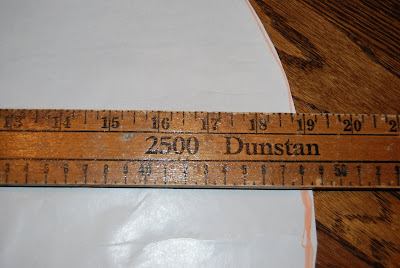 The reason I took the tracing after I bought the saddle is to have something to send to a sidesaddle broker if the one I bought will not work. Many American Saddlebreds are very fine boned and narrow. I actually have a 4 year old built this way...but he is way to young to learn the sidesaddle now. The saddle I bought is also so overstuffed that maybe it would work - if that problem was worked on...but if not - I will be on the search again.

..and since his mane is covering his high withers, it does not look so bad in this photo. In reality, it is somewhere in between.

This is Chastain's withers tracing. I had to use baling wire because - well that is all I had. I would have taken pictures of me doing this with the horse...but I was too busy convincing Chastain the wire was not the enemy and that I still loved him! Yes - I used some ugly Christmas wrapping paper to make the tracing because it was the only paper I had that was wide enough!

I thought Chastain was an extremely wide horse..but now I think I was wrong. Someone will have to help me here - but is 19 inches wide? It sure looks narrow to me.

I knew Chastain had a very pronounced wither, but maybe it was either his general size or the soft back that made me think he was so wide. A pronounced wither seems to be a good thing for getting a better fit with a sidesaddle.
 The reason I took the tracing after I bought the saddle is to have something to send to a sidesaddle broker if the one I bought will not work. Many American Saddlebreds are very fine boned and narrow. I actually have a 4 year old built this way...but he is way to young to learn the sidesaddle now. The saddle I bought is also so overstuffed that maybe it would work - if that problem was worked on...but if not - I will be on the search again.
Subscribe to:
Posts (Atom)
